Skip to content
ScienceBlog.com
  • Topics
    • Brain & Behavior
    • Earth, Energy & Environment
    • Health
    • Technology
    • Life & Non-humans
    • Physics & Mathematics
    • Space
  • Our Bloggers
  • Our Substack
  • Follow Us!
    • Bluesky
    • Threads
    • FaceBook
    • Google News
    • Twitter/X
  • Contribute/Contact

Space

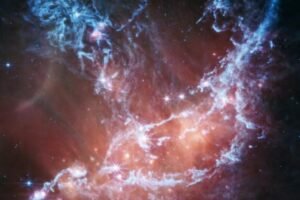
This new infrared image of NGC 346 from NASA’s James Webb Space Telescope’s Mid-Infrared Instrument (MIRI) traces emission from cool gas and dust. In this image blue represents silicates and sooty chemical molecules known as polycyclic aromatic hydrocarbons, or PAHs. More diffuse red emission shines from warm dust heated by the brightest and most massive stars in the heart of the region. Bright patches and filaments mark areas with abundant numbers of protostars. This image includes 7.7-micron light shown in blue, 10 microns in cyan, 11.3 microns in green, 15 microns in yellow, and 21 microns in red (770W, 1000W, 1130W, 1500W, and 2100W filters, respectively).

NASA’s Webb captures an ethereal view of NGC 346

Categories Space
This raw image from the Curiosity Rover shows the hexagon-shaped mudcracks filled with salt.

New insights into the potential for early steps of biological evolution on Mars

Categories Life & Non-humans, Space
A huge storm dominates the rather featureless surface of Saturn in an image taken by the Cassini spacecraft on Feb. 25, 2011, about 12 weeks after the powerful storm was first detected in the planet's northern hemisphere. The megastorm is seen overtaking itself as it encircles the entire planet. Astronomers have found deep in the atmosphere the aftereffects of megastorms that occurred hundreds of years ago. The dark stripes are the shadows of Saturn's rings.

Hundred-year storms? That’s how long they last on Saturn.

Categories Space
This artist’s concept shows stars, black holes, and nebula laid over a grid representing the fabric of space-time. Ripples in this fabric are called gravitational waves. The NANOGrav collaboration detected evidence of gravitational waves created by black holes billions of times the mass of the Sun. Credit: NANOGrav collaboration; Aurore Simonet

15 Years of Radio Data Reveals Evidence of Space-Time Murmur

Categories Physics & Mathematics, Space
Image of the asteroid Dimorphos, with compass arrows, scale bar, and color key for reference. The north and east compass arrows show the orientation of the image on the sky. Note that the relationship between north and east on the sky (as seen from below) is flipped relative to direction arrows on a map of the ground (as seen from above).

Hubble sees boulders escaping from asteroid dimorphos

Categories Space
Bands of rocks may have been formed by a very fast, deep river – the first such evidence found for on Mars

Wild river on Mars emerges from images, rock evidence

Categories Space
The Hubble Space Telescope has captured an image of an object in the ultraviolet part of the spectrum, which appears similar in size to our Milky Way. Researchers have been puzzled by this object for some time, but recently found similarities between it and a nearby galaxy known as IC 5249, which lacks a bulge and is observed edge-on. The images in ultraviolet and visible light of both objects are strikingly similar and suggest that the object could be a galaxy without a bulge viewed edge-on. Credit for the images goes to HST.

Starry Trail Not a Fleeing Black Hole After All

Categories Physics & Mathematics, Space
New modeling shows that there likely is an ocean layer in four of Uranus’ major moons: Ariel, Umbriel, Titania, and Oberon. Salty – or briny – oceans lie under the ice and atop layers of water-rich rock and dry rock. Miranda is too small to retain enough heat for an ocean layer. Credit: NASA/JPL-Caltech

Uranus Moons Hide Watery Secrets

Categories Space
Illustration: Bibiana Prinoth

Scientists discover rare element terbium in exoplanet’s atmosphere

Categories Space
A big ol explosion somewhere out there

Scientists observe flattest explosion ever seen in space

Categories Physics & Mathematics, Space
Part of the set-up for creating medium-density amorphous ice

Discovery of new ice may change understanding of water

Categories Physics & Mathematics
Mimas’ heavily cratered surface (left) suggests a cold history, but its librations rule out a homogeneous interior. Rather, Mimas must have a rocky interior and outer hydrosphere, which could include a liquid ocean (Option A) or be fully frozen with an irregularly shaped core (Option B). An ocean provides a better fit to the phase of the libration but is difficult to reconcile with Mimas’ geology.

More evidence that Saturn’s moon Mimas is a stealth ocean world

Categories Space
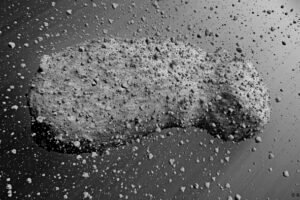
Asteroid Itokawa

Nukes needed to save Earth from common killer asteroid

Categories Space
Older posts
Newer posts
← Previous Page1 Page2 Page3 Page4 Next →

Bloggers

  • Cities of tomorrow: young Poles share vision for smarter, greener living
  • On the City of Fresno’s laudable waste-handling programs
  • Serving California’s PG&E, world’s first ultra-long duration hybrid green hydrogen energy storage microgrid moves forward
  • Truing the Sun
  • Hidden hunger in Europe: well fed yet undernourished
  • Where curiosity meets innovation: EU science fair in Belgium dazzles young minds
  • Spiralling weather and climate impacts documented in WMO report
Substack subscription form sign up

© 2026 ScienceBlog.com | Follow our RSS / XML feed