Skip to content
ScienceBlog.com
  • Topics
    • Brain & Behavior
    • Earth, Energy & Environment
    • Health
    • Technology
    • Life & Non-humans
    • Physics & Mathematics
    • Space
  • Our Bloggers
  • Our Substack
  • Follow Us!
    • Bluesky
    • Threads
    • FaceBook
    • Google News
    • Twitter/X
  • Contribute/Contact

planetary science

Figure 1: A Relict Glacier near Mars’ Equator. (NASA MRO HiRISE and CRISM false color composite. Lee et al. 2023).

Glacier near Mars equator implies water possibly present today

Categories Life & Non-humans, Space
Solar system montage of the nine planets and moons of Jupiter in our solar system.

The planet that could end life on Earth

Categories Space
Mimas’ heavily cratered surface (left) suggests a cold history, but its librations rule out a homogeneous interior. Rather, Mimas must have a rocky interior and outer hydrosphere, which could include a liquid ocean (Option A) or be fully frozen with an irregularly shaped core (Option B). An ocean provides a better fit to the phase of the libration but is difficult to reconcile with Mimas’ geology.

More evidence that Saturn’s moon Mimas is a stealth ocean world

Categories Space
A meteorite thin section under a microscope. Different colors represent different minerals, because light travels through them in different ways. The round mineral aggregates are chondrules, which are a major component in primitive meteorites.

Solar System formed from “poorly mixed cake batter”

Categories Space
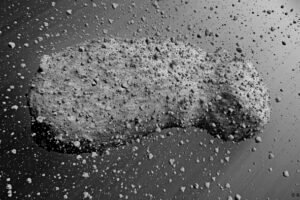
Asteroid Itokawa

Nukes needed to save Earth from common killer asteroid

Categories Space
Boudinage in brecciated dolostone rocks of the Panamint Range (Wildrose Area, Death Valley National Park). New research shows that periclase is stronger than bridgmanite in earth's lower mantle, analogous to boudins developing in rigid ("stronger") rocks among less competent ("weaker") rocks.

What Are They Up To? Surprising Behavior of Minerals Deep in the Earth

Categories Earth, Energy & Environment
Samples of asteroid Ryugu analysed at IPGP

Ryugu: Asteroid samples continue to shed light on solar system history

Categories Space
Artist's impression of an active mantle plume – a large blob of warm and buoyant rock – rising from deep inside Mars and pushing up Elysium Planitia, a plain within the planet's northern lowlands.

Giant plume shows Mars still active

Categories Space
Newer posts
← Previous Page1 … Page3 Page4

Bloggers

  • Cities of tomorrow: young Poles share vision for smarter, greener living
  • On the City of Fresno’s laudable waste-handling programs
  • Serving California’s PG&E, world’s first ultra-long duration hybrid green hydrogen energy storage microgrid moves forward
  • Truing the Sun
  • Hidden hunger in Europe: well fed yet undernourished
  • Where curiosity meets innovation: EU science fair in Belgium dazzles young minds
  • Spiralling weather and climate impacts documented in WMO report
Substack subscription form sign up

© 2026 ScienceBlog.com | Follow our RSS / XML feed