Skip to content
ScienceBlog.com
  • Topics
    • Brain & Behavior
    • Earth, Energy & Environment
    • Health
    • Technology
    • Life & Non-humans
    • Physics & Mathematics
    • Space
  • Our Bloggers
  • Our Substack
  • Follow Us!
    • Bluesky
    • Threads
    • FaceBook
    • Google News
    • Twitter/X
  • Contribute/Contact

physics

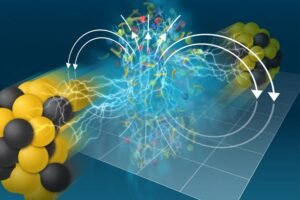
Collisions of heavy ions generate an immensely strong electromagnetic field. Scientists investigate traces of this powerful electromagnetic field in the quark-gluon plasma (QGP), a state where quarks and gluons are liberated from the colliding protons and neutrons.

Super strong magnetic fields leave imprint on nuclear matter

Categories Physics & Mathematics
A proton’s valence quarks (blue, red, and green), quark-antiquark pairs, and gluons (springs). Scalar gluon activity (pink) extends beyond the electric charge radius (orange) that surrounds the gluonic energy core (yellow).

Scientists Locate the Missing Mass Inside the Proton

Categories Earth, Energy & Environment, Physics & Mathematics
For the first time, MIT physicists have captured direct images of “second sound,” the movement of heat sloshing back and forth within a superfluid. The results will expand scientists’ understanding of heat flow in superconductors and neutron stars. Credits:Image: Jose-Luis Olivares, MIT

MIT physicists capture the first sounds of heat “sloshing” in a superfluid

Categories Physics & Mathematics
For decades scientists have been trying to solve Feynman’s Sprinkler Problem: How does a sprinkler running in reverse—in which the water flows into the device rather than out of it—work? Through a series of experiments, a team of mathematicians has figured out how flowing fluids exert forces and move structures, thereby revealing the answer to this long-standing mystery. “Our study solves the problem by combining precision lab experiments with mathematical modeling that explains how a reverse sprinkler operates,” explains Leif Ristroph, an associate professor at New York University’s Courant Institute of Mathematical Sciences and the senior author of the paper, appears in the journal Physical Review Letters. “We found that the reverse sprinkler spins in the ‘reverse’ or opposite direction when taking in water as it does when ejecting it, and the cause is subtle and surprising.” “The regular or ‘forward’ sprinkler is similar to a rocket, since it propels itself by shooting out jets,” adds Ristroph. “But the reverse sprinkler is mysterious since the water being sucked in doesn’t look at all like jets. We discovered that the secret is hidden inside the sprinkler, where there are indeed jets that explain the observed motions.” The research answers one of the oldest and most difficult problems in the physics of fluids. And while Ristroph recognizes there is modest utility in understanding the workings of a reverse sprinkler—“There is no need to ‘unwater’ lawns,” he says—the findings teach us about the underlying physics and whether we can improve the methods needed to engineer devices that use flowing fluids to control motions and forces. “We now have a much better understanding about situations in which fluid flow through structures can induce motion,” notes Brennan Sprinkle, an assistant professor at Colorado School of Mines and one of the paper’s co-authors. “We think these methods we used in our experiments will be useful for many practical applications involving devices that respond to flowing air or water.” The Feynman sprinkler problem is typically framed as a thought experiment about a type of lawn sprinkler that spins when fluid, such as water, is expelled out of its S-shaped tubes or “arms.” The question asks what happens if fluid is sucked in through the arms: Does the device rotate, in what direction, and why? The problem is associated with pioneers in physics, from Ernst Mach, who posed the problem in the 1880s, to the Nobel laureate Richard Feynman, who worked on and popularized it from the 1960s through 1980s. It has since spawned numerous studies that debate the outcome and the underlying physics—and to this day it is presented as an open problem in physics and in fluid mechanics textbooks. In setting out to solve the reverse sprinkler problem, Ristroph, Sprinkle, and their co-authors, Kaizhe Wang, an NYU doctoral student at the time of the study, and Mingxuan Zuo, an NYU graduate student, custom manufactured sprinkler devices and immersed them in water in an apparatus that pushes in or pulls out water at controllable rates. To let the device spin freely in response to the flow, the researchers built a new type of ultra-low-friction rotary bearing. They also designed the sprinkler in a way that enabled them to observe and measure how the water flows outside, inside, and through it. “This has never been done before and was key to solving the problem,” Ristroph explains. To better observe the reverse sprinkler process, the researchers added dyes and microparticles in the water, illuminated with lasers, and captured the flows using high-speed cameras. The results showed that a reverse sprinkler rotates much more slowly than does a conventional one—about 50 times slower—but the mechanisms are fundamentally similar. A conventional forward sprinkler acts like a rotating version of a rocket powered by water jetting out of the arms. A reverse sprinkler acts as an “inside-out rocket,” with its jets shooting inside the chamber where the arms meet. The researchers found that the two internal jets collide but they do not meet exactly head on, and their math model showed how this subtle effect produces forces that rotate the sprinkler in reverse. The team sees the breakthrough as potentially beneficial to harnessing climate-friendly energy sources. “There are ample and sustainable sources of energy flowing around us—wind in our atmosphere as well as waves and currents in our oceans and rivers,” says Ristroph. “Figuring out how to harvest this energy is a major challenge and will require us to better understand the physics of fluids.” The work was supported by a grant from the National Science Foundation (DMS-1646339).

How does Richard Feynman’s “reverse sprinkler” work?

Categories Physics & Mathematics
Still image of trapped gas atoms

Scientists trap krypton atoms to form one-dimensional gas

Categories Physics & Mathematics
brain cell networks

Surprisingly simple model explains how brain cells organize and connect

Categories Brain & Behavior
Optical tweezers, shown here trapping a nanoparticle, are among the systems impacted by a type of uncertainty that physicists have long missed. (image: Steven Hoekstra/Wikipedia CC BY-SA 4.0)

Physicists identify overlooked uncertainty in real-world experiments

Categories Physics & Mathematics
To simplify the solving of massive numbers of partial differential equations (PDEs) for computational modeling, new data-driven surrogate models compute the goal property of a solution to PDEs rather than the whole solution. Credits:Image: Joshua Sortino/Unsplash

Technique could efficiently solve partial differential equations for numerous applications

Categories Physics & Mathematics

Is there really a conflict between General Relativity and Quantum Mechanics?

Categories Bloggers
ice illustration

Even far below freezing, ice’s surface begins melting as temperatures rise

Categories Earth, Energy & Environment, Physics & Mathematics
Laser setup for cooling, controlling, and entangling individual molecules. Photo by Richard Soden, Department of Physics

Physicists ‘entangle’ individual molecules for the first time

Categories Physics & Mathematics, Technology
Ohio State logo

Agostini is awarded Nobel Prize, while Ohio State cheers

Categories Technology
The image depicts an experiment in which heavy particles (illustrated as the moon), cause an interference pattern (a quantum effect), while also bending spacetime. The hanging pendulums depict the measurement of spacetime. The actual experiment is typically performed using Carbon-60, one of the largest known molecules. The UCL calculation indicates that the experiment should also be performed using higher density atoms such as gold. The other two images represent the two experiments proposed by the UCL group, both of which constrain any theory where spacetime is treated classically. One is the weighing of a mass, the other is an interference experiment.

New theory unites Einstein’s gravity with quantum mechanics

Categories Physics & Mathematics
Older posts
Newer posts
← Previous Page1 Page2 Page3 Page4 Page5 Next →

Bloggers

  • Cities of tomorrow: young Poles share vision for smarter, greener living
  • On the City of Fresno’s laudable waste-handling programs
  • Serving California’s PG&E, world’s first ultra-long duration hybrid green hydrogen energy storage microgrid moves forward
  • Truing the Sun
  • Hidden hunger in Europe: well fed yet undernourished
  • Where curiosity meets innovation: EU science fair in Belgium dazzles young minds
  • Spiralling weather and climate impacts documented in WMO report
Substack subscription form sign up

© 2026 ScienceBlog.com | Follow our RSS / XML feed