Skip to content
ScienceBlog.com
  • Topics
    • Brain & Behavior
    • Earth, Energy & Environment
    • Health
    • Technology
    • Life & Non-humans
    • Physics & Mathematics
    • Space
  • Our Bloggers
  • Our Substack
  • Follow Us!
    • Bluesky
    • Threads
    • FaceBook
    • Google News
    • Twitter/X
  • Contribute/Contact

physics

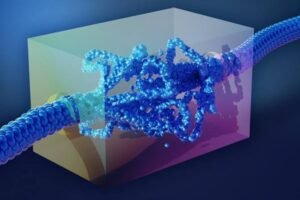
In a strange metal (translucent box), electrons (blue marbles) lose their individuality and melt into a featureless, liquid-like stream.

Can Electricity Flow Without Electrons?

Categories Earth, Energy & Environment, Physics & Mathematics
mpemba effect

Hot Water Freezes Faster Than Cold? Scientists Finally Solve 2,000-Year-Old Physics Puzzle

Categories Physics & Mathematics
An artist’s interpretation of how a new computer code called QUADCOIL refines the design of stellarator fusion machines

New Code Slashes Design Time for Fusion’s Complex Magnetic Puzzles

Categories Earth, Energy & Environment, Physics & Mathematics, Technology

Physical time and Time as we experience it

Categories Bloggers
The SuperMUC-NG at the Leibniz Supercomputing Centre is the eighth fastest computer in the world.

New method significantly reduces AI energy consumption

Categories Earth, Energy & Environment, Technology
An early-career physicist mathematically connects timelike and spacelike form factors, opening the door to further insights into the inner workings of the strong force. A new lattice QCD calculation connects two seemingly disparate reactions involving the pion, the lightest particle governed by the strong interaction. One reaction is known as the spacelike process, where an electron is bounced off a pion. The second reaction, known as the timelike process, is when an electron and antielectron collide, annihilate each other, and produce two pions. The lattice QCD numerical calculation is simultaneously able to describe the spacelike and timelike processes, demonstrating the interconnectedness of different reactions described by QCD. While this connection had been observed experimentally, now physicists have the math to corroborate it.

Physicists Crack the Code Between Matter and Antimatter Collisions in Groundbreaking Calculation

Categories Physics & Mathematics
The new adaptive optical devices are designed to deliver ring-like targeted heating patterns to the surface of the 34-cm-diameter core optics in LIGO to control the effect of increasing thermal distortion as the laser power is increased toward the megawatt scale.

New technology enhances gravitational-wave detection

Categories Physics & Mathematics, Technology
Stony Brook University physicists Gabor David and Axel Drees sketch out how a signal of jet energy loss in deuteron-gold collisions at the Relativistic Heavy Ion Collider (RHIC) supports the case that these collisions create small specks of quark-gluon plasma, a form of matter that permeated the early universe.

Scientists Find Evidence of Primordial Soup in Tiny Nuclear Collisions

Categories Physics & Mathematics
abstract explosion illustration

Scientists Propose Revolutionary Simplification: All Physical Measurements Could Use Just One Unit

Categories Physics & Mathematics
Particle that only has mass when moving in one direction observed for first time

Particle that only has mass when moving in one direction observed for first time

Categories Physics & Mathematics
An illustration of a quantum system that was simulated by both classical and quantum computers. The highlighted sections show how the influence of the system’s components is confined to nearby neighbors.

Plato told us that TRUE = BEAUTIFUL

Categories Bloggers
Researchers showed that a laser beam can sometimes act like a solid object and cast a shadow that is visible to the naked eye. In the picture, the shadow appears as the horizontal line traversing the blue background.

Scientists Make Light Cast a Shadow for First Time

Categories Physics & Mathematics
Ill. Niklas Elmehed © Nobel Prize Outreach

Physics Pioneers Awarded Nobel Prize for Machine Learning Breakthroughs

Categories Physics & Mathematics, Technology
Older posts
Page1 Page2 … Page5 Next →

Bloggers

  • Cities of tomorrow: young Poles share vision for smarter, greener living
  • On the City of Fresno’s laudable waste-handling programs
  • Serving California’s PG&E, world’s first ultra-long duration hybrid green hydrogen energy storage microgrid moves forward
  • Truing the Sun
  • Hidden hunger in Europe: well fed yet undernourished
  • Where curiosity meets innovation: EU science fair in Belgium dazzles young minds
  • Spiralling weather and climate impacts documented in WMO report
Substack subscription form sign up

© 2026 ScienceBlog.com | Follow our RSS / XML feed