Skip to content
ScienceBlog.com
  • Topics
    • Brain & Behavior
    • Earth, Energy & Environment
    • Health
    • Technology
    • Life & Non-humans
    • Physics & Mathematics
    • Space
  • Our Bloggers
  • Our Substack
  • Follow Us!
    • Bluesky
    • Threads
    • FaceBook
    • Google News
    • Twitter/X
  • Contribute/Contact

optical links

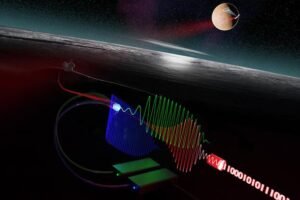
In the new communication system from researchers at Chalmers University of Technology, in Sweden, a weak optical signal (red) from the spacecraft's transmitter can be amplified noise-free when it encounters two so-called pump waves (blue and green) of different frequencies in a receiver on Earth. Thanks to the researchers' noise-free amplifiers in the receiver, the signal is kept undisturbed and the reception on Earth becomes record-sensitive, which in turn paves the way for a more error-free and faster data transmission in space in the future.

Faster space communication with record-sensitive receiver

Categories Space, Technology

Bloggers

  • Cities of tomorrow: young Poles share vision for smarter, greener living
  • On the City of Fresno’s laudable waste-handling programs
  • Serving California’s PG&E, world’s first ultra-long duration hybrid green hydrogen energy storage microgrid moves forward
  • Truing the Sun
  • Hidden hunger in Europe: well fed yet undernourished
  • Where curiosity meets innovation: EU science fair in Belgium dazzles young minds
  • Spiralling weather and climate impacts documented in WMO report
Substack subscription form sign up

© 2026 ScienceBlog.com | Follow our RSS / XML feed