Skip to content
ScienceBlog.com
  • Topics
    • Brain & Behavior
    • Earth, Energy & Environment
    • Health
    • Technology
    • Life & Non-humans
    • Physics & Mathematics
    • Space
  • Our Bloggers
  • Our Substack
  • Follow Us!
    • Bluesky
    • Threads
    • FaceBook
    • Google News
    • Twitter/X
  • Contribute/Contact

Evolution

Human bipedalism – walking upright on two legs – may have evolved in trees, and not on the ground as previously thought, according to a new study involving UCL researchers.

Early humans may have first walked upright in the trees

Categories Brain & Behavior, Life & Non-humans
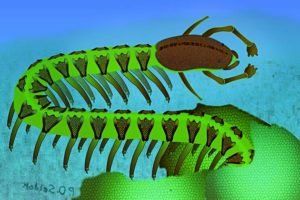
Fossils from the Fezouata Shale. From left to right, a non-mineralized arthropod (Marrellomorpha), a palaeoscolecid worm and a trilobites

Giant arthropods dominated the seas 470 million years ago

Categories Life & Non-humans
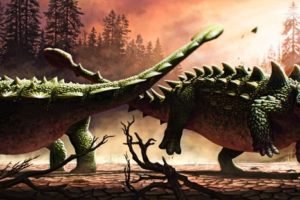
Zuul crurivastator in battle, illustrated by Henry Sharpe. © Henry Sharpe

Ankylosaurs battled each other as much as they fought off T. rex

Categories Life & Non-humans
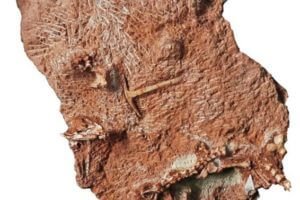
Fossil – the whole specimen showing the skull (left) and skeleton (base of specimen)

Fossil discovery in storeroom cupboard shifts origin of modern lizard back 35 million years

Categories Life & Non-humans
A Whatcheeria skull in the collections of the Field Museum, with its many sharp teeth visible

Ancient superpredator got big by front-loading its growth in its youth

Categories Life & Non-humans
Octopuses have complex “camera” eyes, as seen here in a juvenile animal

What octopus and human brains have in common

Categories Brain & Behavior, Life & Non-humans
Artist's impression of an individual 525-million-year-old Cardiodictyon catenulum on the shallow coastal sea floor, emerging from the shelter of a small stromatolite built by photosynthetic bacteria.

525-million-year-old fossil defies textbook explanation for brain evolution

Categories Brain & Behavior, Life & Non-humans
Researchers at New Jersey Institute of Technology and Colorado State University have reported the discovery of the oldest army ant on record, preserved in Baltic amber dating to the Eocene (~35 million years ago).

Oldest army ant ever discovered reveals iconic predator once raided Europe

Categories Life & Non-humans
Mars rover Perseverance helped scientists study layered rocks like these in Jezero Crater on the Martian surface. Scientists initially thought they were sedimentary rocks, but further examination showed them to be igneous rocks – solidified lava. These rocks show evidence of interaction with water, but on a limited basis. They date back nearly 4 billion years, giving scientists a window into what conditions on the early planets were like. (Image/NASA/JPL-Caltech/ASU)

Mars was covered by 300 meter deep oceans

Categories Space
Newer posts
← Previous Page1 … Page10 Page11

Bloggers

  • Cities of tomorrow: young Poles share vision for smarter, greener living
  • On the City of Fresno’s laudable waste-handling programs
  • Serving California’s PG&E, world’s first ultra-long duration hybrid green hydrogen energy storage microgrid moves forward
  • Truing the Sun
  • Hidden hunger in Europe: well fed yet undernourished
  • Where curiosity meets innovation: EU science fair in Belgium dazzles young minds
  • Spiralling weather and climate impacts documented in WMO report
Substack subscription form sign up

© 2026 ScienceBlog.com | Follow our RSS / XML feed