Skip to content
ScienceBlog.com
  • Topics
    • Brain & Behavior
    • Earth, Energy & Environment
    • Health
    • Technology
    • Life & Non-humans
    • Physics & Mathematics
    • Space
  • Our Bloggers
  • Our Substack
  • Follow Us!
    • Bluesky
    • Threads
    • FaceBook
    • Google News
    • Twitter/X
  • Contribute/Contact

Physics & Mathematics

Researchers found that they can control how tightly bound excitons (electron-hole pairs) are in a magnetic material by changing its magnetic state, which could lead to new ways to switch materials' properties for future technologies like spintronics.

Scientists Unlock Magnetic ‘Light Switch’ for Next-Generation Quantum Computers

Categories Physics & Mathematics, Technology
The new adaptive optical devices are designed to deliver ring-like targeted heating patterns to the surface of the 34-cm-diameter core optics in LIGO to control the effect of increasing thermal distortion as the laser power is increased toward the megawatt scale.

New technology enhances gravitational-wave detection

Categories Physics & Mathematics, Technology
A crystal used in the study charges under UV light. The process created by the University of Chicago Pritzker School of Molecular Engineering Zhong Lab could be used with a variety of materials, taking advantage of rare earths’ powerful, flexible optical properties.

Terabytes of data in a millimeter crystal

Categories Physics & Mathematics, Technology
a, Side and top views of the event. The reconstructed trajectory of the muon is shown as a red line, along with an artist’s representation of the Cherenkov light cone. The hits of individual PMTs are represented by spheres stacked along the direction of the PMT orientations. Only the first five hits on each PMT are shown. As indicated in the legend, the spheres are coloured according to the detection time relative to the first triggered hit. The size of the spheres is proportional to the number of photons detected by the corresponding PMT. The locations of the secondary cascades, discussed in the Supplementary Material, are indicated by the black spheres along the muon trajectory. The north direction is indicated by a red arrow. A 100-m scale and the Eiffel Tower (330 m height, 125 m base width) are shown for size comparison. b, Zoomed-in view of the optical modules that are close to the first two observed secondary showers in the event. Here light-blue spheres represent hits that arrive within −5 to 25 ns of the expected Cherenkov arrival times.

Most Powerful Ghost Particle Ever Detected Unlocks New View of the Cosmos

Categories Physics & Mathematics
This wide field shows the extended stellar halo of NGC 6505 and showcases the Einstein ring, surrounded by colourful foreground stars and background galaxies.

Europe’s New Space Telescope Finds Perfect ‘Ring of Light’ Predicted by Einstein

Categories Physics & Mathematics, Space, Technology
Hot Jupiter

Temperamental stars are distorting our view of distant planets

Categories Physics & Mathematics, Space
No quantum exorcism for Maxwell's demon (but it doesn't need one)

Quantum Loophole Could Break Nature’s Speed Limit

Categories Physics & Mathematics
Starquakes give scientists a peek into neutron stars. Credit: NASA/JPL-Caltech

Neutron Starquakes Could Shake Up Nuclear Physics

Categories Physics & Mathematics, Space
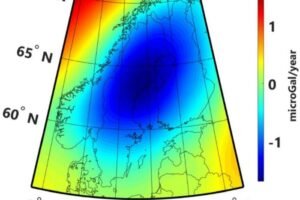
The plot shows the gravity change in Fennoscandia obtained by satellite gravimetry mission (GRACE mission) and a land uplift model. The unit is microGal/year. The gal is defined as 1 centimeter per second squared (1 cm/s2).

Ice Age Aftermath: Nordic Land Mass Rising as Earth’s Gravity Shifts

Categories Earth, Energy & Environment, Physics & Mathematics
LEDA 1313424, aptly nicknamed the Bullseye, is two and a half times the size of our Milky Way and has nine rings — six more than any other known galaxy. High-resolution imagery from NASA’s Hubble Space Telescope confirmed eight rings, and data from the W. M. Keck Observatory in Hawaii confirmed a ninth. Hubble and Keck also confirmed which galaxy dove through the Bullseye, creating these rings: the blue dwarf galaxy that sits to its immediate center-left.

Cosmic Bull’s-Eye: Monster Galaxy’s Nine Rings Reveal Epic Space Collision

Categories Physics & Mathematics, Space, Technology
Angry child

Parents’ Math Fears Could Be Sabotaging Their Children’s Future Success

Categories Brain & Behavior, Physics & Mathematics
clouds

German Scientists Launch Ambitious Project to Capture Clouds in 3D

Categories Earth, Energy & Environment, Physics & Mathematics, Technology
(A) Polar bear sliding down a snow slope at Sallyhamna, Spitsbergen Island, Svalbard, Norway. (B) Infrared image showing the temperature of the polar bear fur and the surrounding snow taken with an FLIR E75 24o (FLIR Systems OÜ, Estonia) Svalbard Archipelago, Norway. (C) Adult female polar bear shakes water from her fur after climbing out of the water onto sea ice. Olgastretet, Barents Sea, Svalbard Archipelago, Norway. (D) An adult male polar bear cleans his fur by rolling and rubbing against snow-covered sea ice. Arctic Ocean, near 81° N, north of Svalbard Archipelago, Norway. Image credits: (A) P. Souders, Getty Images; (B) J. Aars, Norsk Polarinstitutt; and (C) and (D) J. E. Ross, LifeOnThinIce.org.

Polar Bears’ Secret Weapon Against Ice Could Revolutionize Aviation Safety

Categories Life & Non-humans, Physics & Mathematics
Older posts
Newer posts
← Previous Page1 … Page3 Page4 Page5 … Page540 Next →

Bloggers

  • Cities of tomorrow: young Poles share vision for smarter, greener living
  • On the City of Fresno’s laudable waste-handling programs
  • Serving California’s PG&E, world’s first ultra-long duration hybrid green hydrogen energy storage microgrid moves forward
  • Truing the Sun
  • Hidden hunger in Europe: well fed yet undernourished
  • Where curiosity meets innovation: EU science fair in Belgium dazzles young minds
  • Spiralling weather and climate impacts documented in WMO report
Substack subscription form sign up

© 2026 ScienceBlog.com | Follow our RSS / XML feed