Skip to content
ScienceBlog.com
  • Topics
    • Brain & Behavior
    • Earth, Energy & Environment
    • Health
    • Technology
    • Life & Non-humans
    • Physics & Mathematics
    • Space
  • Our Bloggers
  • Our Substack
  • Follow Us!
    • Bluesky
    • Threads
    • FaceBook
    • Google News
    • Twitter/X
  • Contribute/Contact

Physics & Mathematics

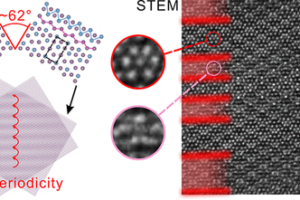
Researchers from the Institute of Industrial Science, The University of Tokyo, discover brand new one-dimensional diffraction patterns in two-dimensional nanomaterials, with exciting implications

Japanese Scientists Discover Strange New Stripes in Twisted Nanomaterials

Categories Physics & Mathematics
The shock-absorbing layer of a bicycle helmet has a geometric structure that absorbs crash forces better than today’s helmets. Photo: Mohammad Hossein Zamani

Shape-Shifting Bike Helmet Could Redefine Cyclist Safety

Categories Brain & Behavior, Health, Physics & Mathematics, Technology
Researchers developed a new interconnect that can support scalable, all-to-all communication between a series of superconducting quantum processors, enabling an information-carrying photon to travel between processors in a user-defined direction. The concept is illustrated here.

Device enables direct communication among multiple quantum processors

Categories Physics & Mathematics, Technology
This side-by-side comparison shows a Spitzer Space Telescope Infrared Array Camera image of HH 49/50 (left) versus a Webb image of the same object (right) using the NIRCam (Near-infrared Camera) instrument and MIRI (Mid-infrared Instrument). The Webb image shows intricate details of the heated gas and dust as the protostellar jet slams into the material. Webb also resolves the “fuzzy” object located at the tip of the outflow into a distant spiral galaxy. The Spitzer image shows 3.6-micron light in blue, the 4.5-micron in green, and the 8.0-micron in red (IRAC1, IRAC2, IRAC4). In the Webb image, blue represents light at 2.0-microns (F200W), cyan represents light at 3.3-microns (F335M), green is 4.4-microns (F444W), orange is 4.7-microns (F470N), and red is 7.7-microns (F770W).

NASA’s Webb Telescope Unmasks True Nature of the Cosmic Tornado

Categories Physics & Mathematics, Space
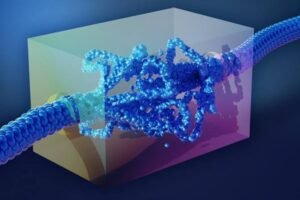
In a strange metal (translucent box), electrons (blue marbles) lose their individuality and melt into a featureless, liquid-like stream.

Can Electricity Flow Without Electrons?

Categories Earth, Energy & Environment, Physics & Mathematics
mpemba effect

Hot Water Freezes Faster Than Cold? Scientists Finally Solve 2,000-Year-Old Physics Puzzle

Categories Physics & Mathematics
Artist’s impression of supermassive black holes (Courtesy of NOIRLab/NSF/AURA/J. daSilva/M. Zamani)

Black Holes: Cosmic Gardeners That Might Actually Nurture Life

Categories Life & Non-humans, Physics & Mathematics, Space
This is part of a new image that shows the vibration directions, or polarization, of the radiation. The zoom-in on the right is 10 degrees high. Polarized light vibrates in a particular direction; blue shows where the surrounding light’s vibration directions are angled towards it, like spokes on a bicycle; orange shows places where the vibration directions circle around it. This new information reveals the motion of the ancient gases in the universe when it was less than half a million years old, pulled by the force of gravity in the first step toward forming galaxies. The red band comes from our closer-by Milky Way.

Telescope Captures Clearest Images of Universe’s Infancy

Categories Physics & Mathematics, Space, Technology
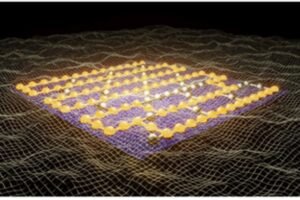
An artist’s impression of a quantum electrodynamics simulation using 100 qubits of an IBM quantum computer. The spheres and lines denote the qubits and connectivity of the IBM quantum processor; gold spheres denote the qubits used in the simulation.

100-Qubit Quantum Leap: Scientists Harness Quantum Computers to Model the Universe’s Fundamental Physics

Categories Physics & Mathematics, Technology
A logarithmic spiral with a diameter of 500 μm, approximately half the diameter of a sewing needle.

Accidental Lab Mishap Reveals Nature’s Hidden Art

Categories Physics & Mathematics
Image of a live mouse embryo with and without optimised capture.

Quantum Camera Tech Illuminates Living Embryos with Unprecedented Gentleness

Categories Life & Non-humans, Physics & Mathematics, Technology
An artist’s interpretation of how a new computer code called QUADCOIL refines the design of stellarator fusion machines

New Code Slashes Design Time for Fusion’s Complex Magnetic Puzzles

Categories Earth, Energy & Environment, Physics & Mathematics, Technology
The purple/blue solution in this vial contains crystals of the berkelocene “sandwich.”

Scientists Find New Heavy Metal Molecule ‘Berkelocene’

Categories Physics & Mathematics
Older posts
Newer posts
← Previous Page1 Page2 Page3 … Page540 Next →

Bloggers

  • Cities of tomorrow: young Poles share vision for smarter, greener living
  • On the City of Fresno’s laudable waste-handling programs
  • Serving California’s PG&E, world’s first ultra-long duration hybrid green hydrogen energy storage microgrid moves forward
  • Truing the Sun
  • Hidden hunger in Europe: well fed yet undernourished
  • Where curiosity meets innovation: EU science fair in Belgium dazzles young minds
  • Spiralling weather and climate impacts documented in WMO report
Substack subscription form sign up

© 2026 ScienceBlog.com | Follow our RSS / XML feed