Skip to content
ScienceBlog.com
  • Topics
    • Brain & Behavior
    • Earth, Energy & Environment
    • Health
    • Technology
    • Life & Non-humans
    • Physics & Mathematics
    • Space
  • Our Bloggers
  • Our Substack
  • Follow Us!
    • Bluesky
    • Threads
    • FaceBook
    • Google News
    • Twitter/X
  • Contribute/Contact

Physics & Mathematics

A gravitational atom. Just as electrons can orbit around the nucleus of an atom, a cloud of previously undiscovered ultralight particles can orbit around pairs of black holes.

Black Hole Mergers Could Reveal Elusive Ultralight Particles

Categories Physics & Mathematics, Space
An artist’s illustration depicts a primordial black hole (at left) flying past, and briefly “wobbling” the orbit of Mars (at right), with the sun in the background. MIT scientists say such a wobble could be detectable by today’s instruments. Credits:Credit: Image by Benjamin Lehmann, using SpaceEngine @ Cosmographic Software LLC.

Mars’ Wobble Could Reveal Dark Matter, MIT Study Suggests

Categories Physics & Mathematics, Space
Variations in chemical composition create spatial disorder in the superconducting properties of the cuprate superconductor La1.83Sr0.17CuO4, represented by the different colored circles. This disorder affects interlayer tunneling, which can be detected through the isolated Josephson echo using angle-resolved two-dimensional terahertz spectroscopy.

Terahertz Light Pulses Unveil Superconductor Secrets

Categories Physics & Mathematics
Early dark energy could have triggered the formation of numerous bright galaxies, very early in the universe, a new study finds. The mysterious unknown force could have caused early seeds of galaxies (depicted at left) to sprout many more bright galaxies (at right) than theory predicts. Credits:Image: Josh Borrow/Thesan Team

Early dark energy could resolve cosmology’s two biggest puzzles

Categories Physics & Mathematics, Space
Gravity map of Mars. The red circles show prominent volcanoes on Mars and the black circles show impact crates with a diameter larger than a few 100 km. A gravity high signal is located in the volcanic Tharsis Region (the red area in the centre right of the image), which is surrounded by a ring of negative gravity anomaly (shown in blue).

Gravity study gives insights into hidden features beneath lost ocean of Mars and rising Olympus Mons

Categories Physics & Mathematics, Space
wall calendar

The Math Behind Meeting Mayhem: Why Scheduling Gets Harder as Groups Grow

Categories Physics & Mathematics
The quasiperiodic landscape in which the new Bose glass forms, similar to a Penrose tiling.

New Phase of Matter Discovered in 2D: Bose Glass Challenges Statistical Mechanics

Categories Physics & Mathematics
The Short-Baseline Neutrino Detector collaboration celebrated the moment the detector began running at 100% voltage.

Neutrino Detector Marks Milestone in Hunt for Elusive Particle

Categories Physics & Mathematics, Technology
galaxy seen from the side

New AI Distinguishes Dark Matter from Cosmic Interference

Categories Physics & Mathematics, Space, Technology
Explosion

Sign of the Times: University Launches Nation’s First Master’s in Explosion Protection

Categories Physics & Mathematics, Social Sciences
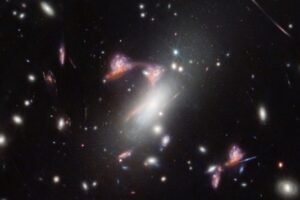
The galaxy cluster MACS-J0417.5-1154 is so massive that it bends the fabric of space-time. This causes the appearance of galaxies behind it to be distorted, an effect known as gravitational lensing. This natural phenomenon magnifies distant galaxies and can also make them appear in an image multiple times, as NASA's James Webb Space Telescope has observed. In this image, two distant, interacting galaxies - a face-on spiral and a dusty red galaxy seen from the side - appear multiple times, tracing a familiar shape across the sky. The fact that these galaxies are actively forming stars and that the face-on galaxy's spiral shape is remarkably intact indicates that their interaction is just beginning.

Webb Telescope Unveils Rare Cosmic ‘Question Mark’ in Distant Galaxy

Categories Physics & Mathematics, Space
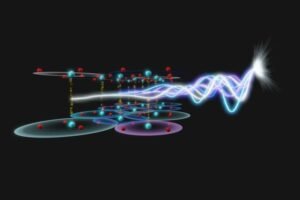
A powerful laser is directed into a jet of gas, forming a bright plasma that generates ultraviolet light. As this light interacts with the remaining gas in the vacuum chamber, it creates a visible white line. This method allows scientists to accurately measure the energy required to excite the thorium-229 nucleus, which is crucial for developing a future nuclear clock.

Nuclear Clocks: The Next Frontier in Ultraprecise Timekeeping

Categories Physics & Mathematics, Technology
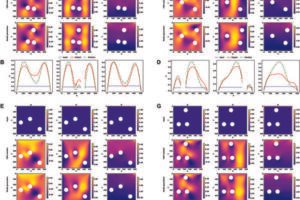
Contour plots (A, C, E, G) compare the input conditions, traditional finite difference method solutions, and the solutions generated by model B3, the most advanced model in the study. Velocity profiles (B, D, F, H) display detailed velocity information at specific cross-sections of the simulation domain.

Deep Learning Accelerates Fluid Dynamics Simulations, Solving Complex Equations 1,000 Times Faster

Categories Physics & Mathematics, Technology
Older posts
Newer posts
← Previous Page1 … Page13 Page14 Page15 … Page540 Next →

Bloggers

  • Cities of tomorrow: young Poles share vision for smarter, greener living
  • On the City of Fresno’s laudable waste-handling programs
  • Serving California’s PG&E, world’s first ultra-long duration hybrid green hydrogen energy storage microgrid moves forward
  • Truing the Sun
  • Hidden hunger in Europe: well fed yet undernourished
  • Where curiosity meets innovation: EU science fair in Belgium dazzles young minds
  • Spiralling weather and climate impacts documented in WMO report
Substack subscription form sign up

© 2026 ScienceBlog.com | Follow our RSS / XML feed