Skip to content
ScienceBlog.com
  • Topics
    • Brain & Behavior
    • Earth, Energy & Environment
    • Health
    • Technology
    • Life & Non-humans
    • Physics & Mathematics
    • Space
  • Our Bloggers
  • Our Substack
  • Follow Us!
    • Bluesky
    • Threads
    • FaceBook
    • Google News
    • Twitter/X
  • Contribute/Contact

Caltech

Caltech is a world-renowned science and engineering research and education institution, where extraordinary faculty and students translate big ideas into big discoveries.
This JWST image shows the Big Wheel galaxy (in the center) and its cosmic environment. The galaxy is a gigantic rotating disk lying 11.7 billion light-years away. Its spiral disk stretches across 100,000 light-years, making it larger than any other galaxy disk confirmed at this epoch of the universe. The blue blob and some of the other larger objects in the image are galaxies in the nearby universe. The smaller objects tend to be distant galaxies; however, the larger galaxy to the lower left of Big Wheel is part of the same remote galactic structure as Big Wheel. Credit: NASA/ESA

Astronomers Find Giant Dinosaur of a Galaxy

Categories Physics & Mathematics, Space
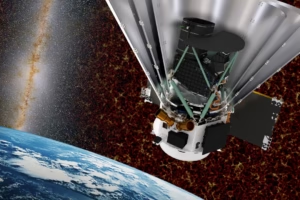
NASA's SPHEREx mission will provide new clues about the explosive, inflationary phase of our universe

What Hundreds of Millions of Galaxies Can Teach Us About the Big Bang

Categories Physics & Mathematics, Space
The fully integrated wireless wearable patch for long COVID monitoring. The scale bar shown for scale is 1 cm.

Tiny Printed Sensors Could Transform Healthcare Through Sweat

Categories Health, Technology
Artistic rendering of the brain's "speed limit" - we think, process, and decide at the slow pace of 10 bits per second.

Human Thought Runs at Just 10 Bits per Second Despite Billions of Neurons

Categories Brain & Behavior
NASA's Europa Clipper is tasked with up-close study of Jupiter's enigmatic moon Europa, which orbits the gas giant within a band of powerful radiation generated by the planet's strong magnetic field. The relative intensity of Jupiter's radiation bands is illustrated in this diagram, along with the orbits of Jupiter's three other largest moons: Io, Ganymede, and Callisto.

Hidden Oceans, Possible Life: NASA’s Mission to Jupiter Moon Could Rewrite Our Cosmic Story

Categories Space
Weill Cornell Medicine investigators used AI to discern subtypes of Parkinson's disease from diverse data sources. Credit: Shutterstock

New Algorithm Lets Neural Networks Learn Continuously Without Forgetting

Categories Physics & Mathematics, Technology
soil

Seismic Technology Reveals Hidden Soil Moisture Using Traffic Noise

Categories Earth, Energy & Environment
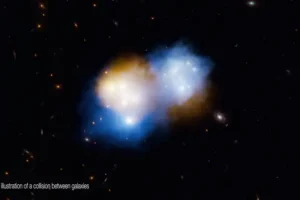
This artist's concept shows what happened when two massive clusters of galaxies, collectively known as MACS J0018.5, collided: The dark matter in the galaxy clusters (blue) sailed ahead of the associated clouds of hot gas, or normal matter (orange). Both dark matter and normal matter feel the pull of gravity, but only the normal matter experiences additional effects like shocks and turbulence that slow it down during collisions.

Dark matter flies ahead of normal matter in mega galaxy cluster collision

Categories Physics & Mathematics, Space
This illustration depicts a binary star system consisting of a dense neutron star and a normal Sun-like star (upper left). Using data from the European Space Agency's Gaia mission, astronomers found several systems like this one, in which the two bodies are widely separated. Because the bodies in these systems are far apart, with separations on average 300 times the size of a Sun-like star, the neutron star is dormant—it is not actively stealing mass from its companion and is thus very faint. To find these hidden neutron stars, the scientists used Gaia observations to look for a wobble in the Sun-like stars caused by a tugging action of the orbiting neutron stars. These are the first neutron stars discovered purely due to their gravitational effects.

Sun-like stars found orbiting hidden companions

Categories Space
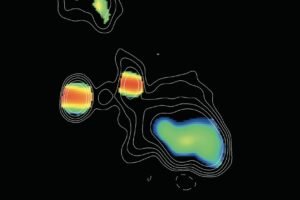
This image, taken by the Very Long Baseline Array (VLBA), shows two supermassive black holes, which appear as the blobs with red strips. The black holes are in the center of an elliptical galaxy. Colors represent different spectral slopes in radio emission, with red showing the most dense regions surrounding the black holes. The black hole on the right has likely recently devoured a massive star, which caused it to shoot out two ultrafast jets. The ends of those jets appear as green blobs above and below the black hole. This object, called J0405+3803, is referred to as a Compact Symmetric Object (CSO), because its jets are relatively close-in (or compact), compared to other black holes with much larger jets.

Sleeping supermassive black holes awakened briefly by shredded stars

Categories Physics & Mathematics, Space
Early earth, with a lake

Meteorite Analysis Shows Earth’s Building Blocks Contained Water

Categories Earth, Energy & Environment
Dramatic plumes spray water ice and vapor from many locations along the famed "tiger stripes" near the south pole of Saturn's moon Enceladus. The tiger stripes are four prominent, approximately 84-mile- (135-kilometer-) long fractures that cross the moon's south polar terrain. Credit: NASA/JPL-Caltech/Space Science Institute

A New Way to Characterize Habitable Planets

Categories Life & Non-humans, Space
circuitboard

Conjoined “Racetracks” Make New Optical Device Possible

Categories Technology
Older posts
Page1 Page2 … Page17 Next →

Bloggers

  • Cities of tomorrow: young Poles share vision for smarter, greener living
  • On the City of Fresno’s laudable waste-handling programs
  • Serving California’s PG&E, world’s first ultra-long duration hybrid green hydrogen energy storage microgrid moves forward
  • Truing the Sun
  • Hidden hunger in Europe: well fed yet undernourished
  • Where curiosity meets innovation: EU science fair in Belgium dazzles young minds
  • Spiralling weather and climate impacts documented in WMO report
Substack subscription form sign up

© 2026 ScienceBlog.com | Follow our RSS / XML feed